Pages

Tuesday, July 15, 2025

Elephant apple, Dillenia indica

Dillenia indica! That’s a super interesting plant—also known as the elephant apple. Here’s a friendly little rundown for you:

🌿 What is Dillenia indica?

  • It’s a tropical tree native to Southeast Asia and parts of India.
  • The name “elephant apple” comes from the fact that elephants love munching on the fruit! 🍎🐘
  • It belongs to the Dilleniaceae family and grows quite large—sometimes up to 15 meters tall.

    🌼 Features:

  • Leaves: Big, leathery, and glossy with prominent veins—kinda dramatic and beautiful.
  • Flowers: Large, white, and super fragrant. A real showstopper when in bloom!
  • Fruits: Big, round, greenish-yellow, and pretty hard. The outer part is a bit sour and fibrous.

    🍴 Uses:

  • The fruit is often used in chutneys, jams, and curries in Indian cuisine—it has a tangy, sour taste.
  • It’s also valued in traditional medicine for its digestive and anti-inflammatory properties.

    🌱 Growing Tips:

  • Light: Loves full sun but can tolerate partial shade.
  • Soil: Prefers moist, well-drained soil—doesn’t like getting too dry.
  • Water: Keep it regularly watered, especially when young or during dry spells.
  • Climate: Thrives in warm, humid conditions—USDA zones 10–12-ish.

    🌟 Uses of Dillenia indica:

    1. Culinary:Unrefined brown sugar made from palm sap or sugarcane juice

  • The fruit is super sour and fibrous—perfect for making:
  • Chutneys (A spicy condiment made of chopped fruits or vegetables cooked in vinegar and sugar with ginger and spices)
  • Jams and jellies
  • Soups and curries (especially in Eastern India and Bangladesh)
  • Often cooked with sugar or jaggery (Unrefined brown sugar made from palm sap or sugarcane juice) to balance the tartness.

    2. Traditional medicine:

  • Used in Ayurveda and folk remedies for:
  • Digestion issues
  • Inflammation
  • As a mild laxative
  • The bark and leaves also have reported antibacterial properties.

    3. Wildlife:

  • Elephants and other animals love the fruit (hence the name)!
  • It also provides food and shelter for birds and insects.

    🌱 Care Tips for Growing Dillenia indica:

    🌞 Light:

  • Full sun is best to encourage healthy flowering and fruiting.
  • Can tolerate partial shade but won't fruit as well.
    💧 Water:
  • Likes consistently moist soil—don’t let it dry out.
  • Good drainage is key to prevent root rot.
    🌡️ Climate:
  • Thrives in tropical/subtropical zones (USDA 10–12).
  • It’s not frost-hardy, so keep it warm and humid.
    🌿 Soil:
  • Rich, loamy soil is ideal.
  • A bit of organic compost goes a long way!
    ✂️ Maintenance:
  • Mulching helps retain moisture and keep roots cool.
  • Wild sweetsop, Annona mucosa

    🌿 Quick Facts About Wild Sweetsop (Annona mucosa)

    🌍 Native Range:

  • Tropical South America — especially Brazil, Peru, and Colombia.

    🌱 Common Names:

  • Wild sweetsop
  • Biribá
  • Lemon meringue fruit (because of its tangy-sweet flavor!)
  • Rollinia (often used in cultivation contexts)

    🌳 Tree Info:

  • Grows 4–15 meters tall
  • Fast-growing and tropical-loving
  • Deciduous in dry seasons
  • Can handle short-term flooding but not frost

    🌸 Flowers:

  • Yellow-green, waxy, and slightly fragrant
  • Have two sets of petals: outer thick and fleshy, inner smaller
  • Pollinated mostly by beetles (not bees!)

    🍈 Fruit:

  • Bright yellow when ripe, with soft spikes
  • Soft, creamy pulp — sweet, custard-like texture
  • Tastes like lemon meringue pie, some say with hints of banana or pineapple
  • Bruises easily and has a short shelf life (not great for supermarkets!)

    🧃 Uses:

  • Eaten fresh with a spoon
  • Blended into juices, smoothies, ice creams, pies, and even wine
  • Sometimes used medicinally in traditional cultures

    🌱 Growing Tips:

  • Loves humidity, warmth, and full sun
  • Prefers rich, well-draining soil
  • Needs consistent watering (but don’t waterlog it)
  • Grows from seed and can fruit in just 2–3 years

    ⚠️ Watch Out For:

  • Cold temperatures — it’s super frost-sensitive
  • Low humidity — poor fruit set if humidity drops below 80%
  • Easily damaged fruit — handle with care!
  • Monday, July 14, 2025

    Cupuaçu, Theobroma grandiflorum

    Theobroma grandiflorum, commonly known as cupuaçu (pronounced koo-poo-ah-SOO), is a tropical fruit tree native to the Amazon rainforest, especially in Brazil, Peru, Colombia, and Bolivia. It's a close relative of the cacao tree (Theobroma cacao).

    🌱 Overview

  • Family: Malvaceae (previously Sterculiaceae)
  • Genus: Theobroma
  • Common Name: Cupuaçu
  • Native Range: Amazon Basin
  • Growth Habit: Small to medium-sized tree, typically 5–20 meters tall

    🌸 Flowers

  • Cupuaçu trees produce small, fragrant, creamy white to pinkish flowers.
  • The flowers are pollinated primarily by small insects, especially midges.

    🍈 Fruit

  • Shape: Oval or oblong, like a cacao pod
  • Size: 20–25 cm long, weighing up to 1–2 kg
  • Rind: Thick and brown, leathery texture
  • Pulp: Creamy, fragrant, tangy, and sweet — often described as a mix of chocolate, pineapple, and banana
  • Seeds: Large and numerous, similar to cacao seeds

    Liqueur

    🌿 Uses

    Culinary:

  • The pulp is used in juices, ice cream, candies, jams, and desserts.
  • Cupuaçu butter (from seeds) is rich in fatty acids and used as a substitute for cocoa butter in chocolate-like products.

    Cosmetic:

  • Cupuaçu butter is valued in skincare for its moisturizing and emollient properties.

    🌍 Ecological & Economic Importance

  • Often grown in agroforestry systems in Brazil.
  • Increasingly popular in international markets for both food and cosmetics.
  • Promotes biodiversity-friendly cultivation in Amazonian communities.
  • Sunday, July 13, 2025

    Chocolate vine, Akebia quinata

    Chocolate Vine (Akebia quinata) is a fast-growing, deciduous to semi-evergreen climbing vine native to East Asia (Japan, China, and Korea). Here's a quick overview of this intriguing plant:

    🌿 Overview

  • Scientific Name: Akebia quinata
  • Common Names: Chocolate vine, Five-leaf akebia
  • Family: Lardizabalaceae
  • Type: Woody vine (deciduous or semi-evergreen)

    🌸 Flowers

  • Color: Deep purple to reddish-brown, sometimes with a chocolate scent
  • Bloom Time: Spring (usually April to May)
  • Appearance: Female flowers are larger and fewer, while smaller male flowers cluster nearby

    🍇 Fruit

  • Type: Sausage-shaped, purplish fruit with a soft, edible pulp inside
  • Taste: Mildly sweet, jelly-like texture
  • Note: Fruit is usually only produced if genetically distinct plants are cross-pollinated

    🌱 Leaves & Growth

  • Leaves: Divided into five oval leaflets (hence "quinata")
  • Growth Habit: Twining vine; can grow 20–40 feet or more in a single season under ideal conditions
  • Hardiness Zones: USDA 4–9
  • Sunlight: Full sun to partial shade
  • Soil: Well-drained, tolerates a range of soil types

    Akebia seeds

    🌿 Uses

  • Ornamental: Pergolas, arbors, fences, or as a groundcover
  • Edible: Fruit pulp is edible, though rare in non-native climates
  • Traditional Uses: In East Asia, used in herbal medicine and the young shoots are occasionally cooked

    ⚠️ Cautions

  • Invasiveness: In some regions of the U.S. (especially the Southeast and Mid-Atlantic), Akebia quinata is considered invasive due to its aggressive growth and tendency to smother native plants
  • Control: Regular pruning and site selection are key to managing spread
  • Blue Tongue,Melastoma affine

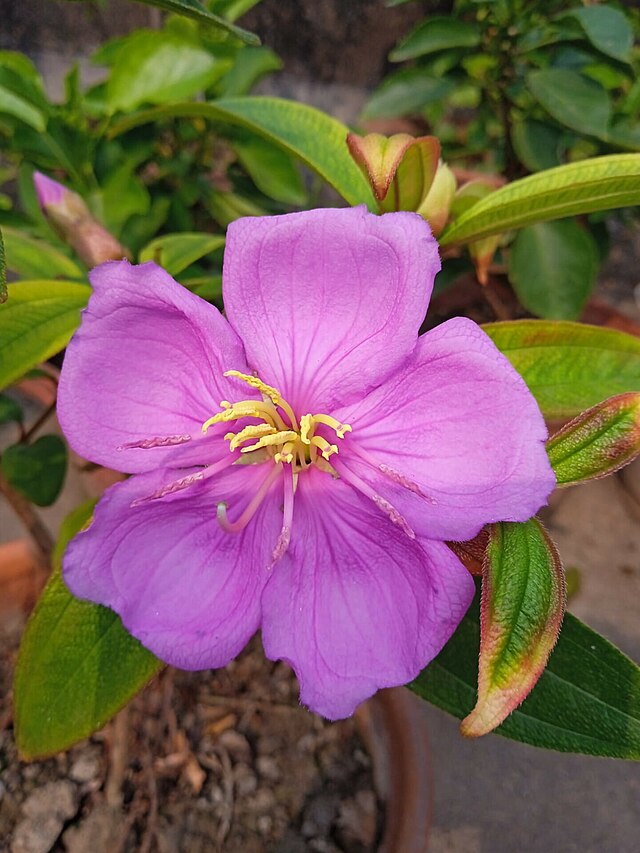
    Melastoma affine, commonly known as blue tongue, is a fast-growing, flowering shrub or small tree native to Southeast Asia and northern Australia. It's a member of the Melastomataceae family and is admired for its striking purple to violet flowers and its role in rainforest regeneration.

    🌿 Quick Facts:

  • Scientific name: Melastoma affine
  • Common names: Blue tongue, Native Lasiandra
  • Family: Melastomataceae
  • Habit: Shrub or small tree (up to 3 meters tall)
  • Leaves: Opposite, ovate, with distinct longitudinal veins
  • Flowers: Large, vibrant purple to mauve with five petals
  • Fruit: Fleshy capsule that splits open when ripe, exposing dark pulp and seeds
  • Blooming season: Spring to summer

    🌸 Notable Features:

  • "Blue tongue" nickname comes from the dark blue-black pulp of the fruit that stains the mouth and tongue when eaten.
  • Pollinator-friendly: Attracts bees, butterflies, and birds.
  • Often used in revegetation projects due to its fast growth and ability to thrive in disturbed soils.
  • Plays an important ecological role in rainforest understories.

    🌱 Cultivation Tips:

  • Light: Prefers full sun to partial shade
  • Soil: Moist, well-draining soil (tolerates a range of conditions)
  • Watering: Regular watering during dry periods
  • Propagation: Easily grown from seed or cuttings
  • Saturday, July 12, 2025

    Arabica coffee, Coffea arabica

    Arabica coffee, scientifically known as Coffea arabica, is the most popular coffee species globally, accounting for approximately 60% of worldwide coffee production. Here are some key facts about it:

    Origin and Cultivation:

  • Native Region: Arabica coffee originated in the highlands of Ethiopia and Yemen.
  • Growing Conditions: It thrives in high altitudes (typically between 2,000 and 6,000 feet above sea level), with consistent rainfall (around 40-59 inches annually), and stable temperatures (ideally 59-75°F or 15-24°C). It prefers light shade, often grown as an understory shrub.
  • Delicate Plant: Arabica plants are more delicate and susceptible to diseases and pests compared to other coffee species, requiring careful cultivation.
  • Maturity: An Arabica coffee plant takes about seven years to fully mature, but can produce economic yields for 30-40 years, and some even up to 100 years.
  • Yield: One Arabica coffee plant produces about one to two pounds of beans per year.
  • Harvesting: The coffee cherries on an Arabica plant don't ripen simultaneously, so they are often hand-picked individually when perfectly ripe to ensure the highest quality.
  • Global Production: Major Arabica-producing countries include Brazil, Colombia, Ethiopia, Honduras, and Peru.

    Characteristics of the Plant and Bean:

  • Self-Pollinating: Unlike many other plants, Arabica coffee is self-pollinating, which helps maintain consistent genetic traits and quality across generations.
  • Chromosomes: Arabica coffee is unique in having 44 chromosomes, double that of most other coffee species (which typically have 22). This higher number of chromosomes is believed to contribute to its more complex and subtle flavor profiles.
  • The "Bean": What we call a "coffee bean" is actually the seed of a fruit called a coffee cherry. Each cherry typically contains two seeds.
  • Appearance: Arabica beans are oval-shaped with a distinctive S-shaped groove in the middle. Unroasted (green) beans are typically greenish to greenish-blue.
  • Flowers: The plant produces small, white, highly fragrant flowers that resemble jasmine.

    Flavor and Caffeine:

  • Flavor Profile: Arabica is renowned for its smooth, sweet, and complex flavor. It often features notes of chocolate, sugar, nuts, and fruits (like berries or citrus), with a pleasant acidity. The specific flavor notes can vary greatly depending on the region and processing methods.
  • Caffeine Content: Arabica has a lower caffeine content compared to Robusta beans, typically ranging from 0.8% to 1.5% caffeine by dry weight. This lower caffeine contributes to its smoother taste and less bitter profile.

    Coffea canephora

    Comparison to Robusta:

  • Arabica is generally considered superior in taste and aroma to Robusta (Coffea canephora), which tends to be stronger, harsher, more bitter, and has a higher caffeine content. Robusta is often used in instant coffee and espresso blends for its crema and bold flavor.

    These facts highlight why Arabica coffee is so widely beloved and constitutes the majority of specialty coffee available worldwide.

  • Thursday, July 10, 2025

    Tasmanian apples

    Tasmanian apples are renowned for their crisp texture, vibrant flavor, and rich heritage. Grown in the cool, clean climate of Tasmania — the island state of Australia — these apples benefit from rich soil, abundant rainfall, and long daylight hours, which produce fruit of exceptional quality.

    Popular Varieties:

  • Pink Lady (Cripps Pink) – sweet-tart with a firm bite.
  • Royal Gala – juicy and mildly sweet.
  • Granny Smith – tart and crisp, good for baking.
  • Fuji – sweet and dense.
  • Jazz and Envy – newer hybrids with bold flavor and crunch.

  • Growing Region: The Huon Valley and Tamar Valley are major apple-producing areas, with orchards dating back to the 1800s.
  • Harvest Season: Typically from February to May (late summer to autumn in the Southern Hemisphere).
  • Uses: Fresh eating, juicing, cider making, and baking. Tasmanian apples are also exported worldwide.

    🌸 Blooms and Trees:

  • Apple trees bloom in early spring, producing fragrant, white-to-pink blossoms before fruit develops.
  • Trees have a compact to medium size with a rounded canopy and glossy green leaves.
  • Bees and other pollinators are crucial for good fruit set.